
Terra Luna Classic (LUNC) Price Outlook: Where the Token Could Be Headed by 2030

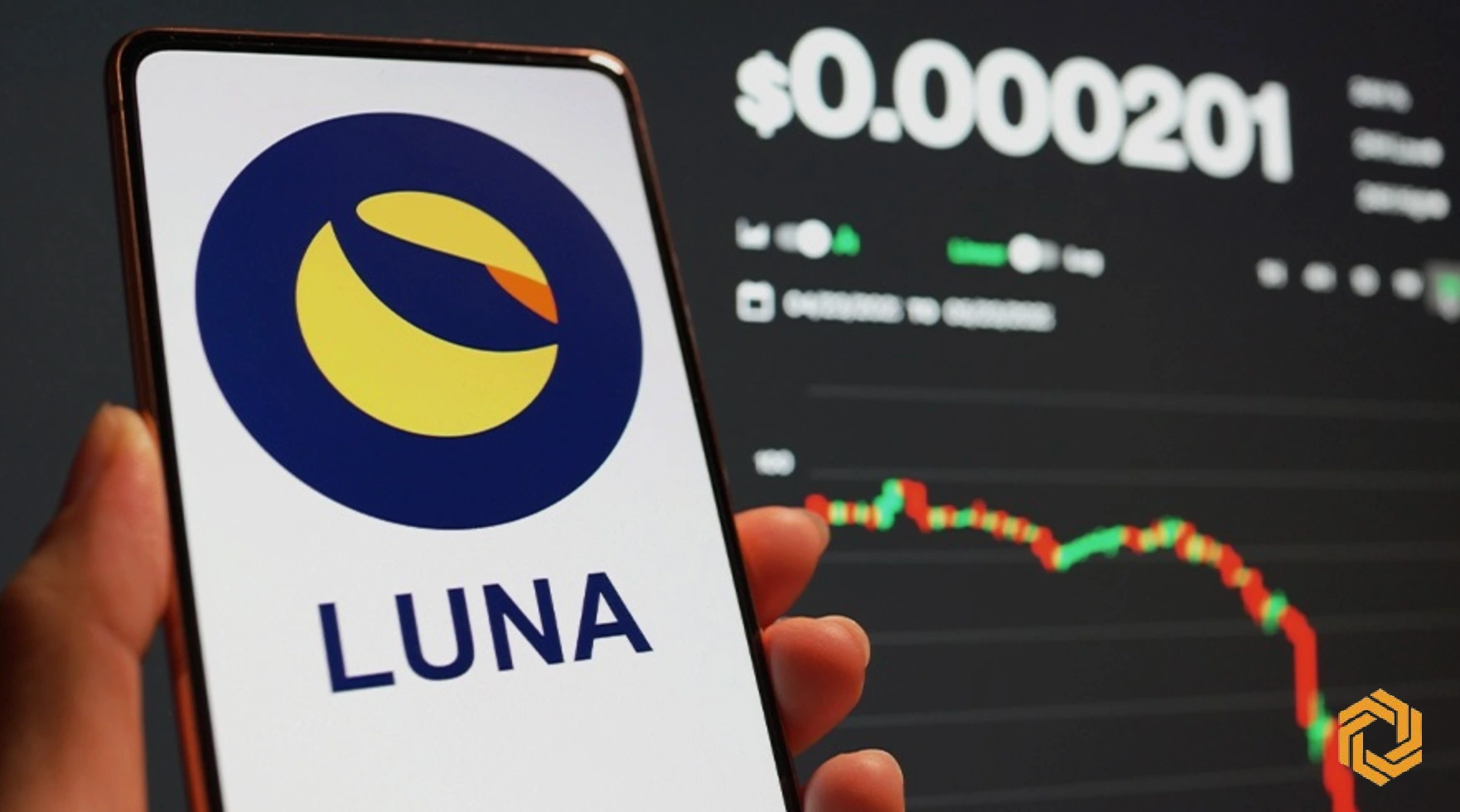
Terra Luna Classic (LUNC) is one of crypto’s most cautionary tales — a token that lost 99.9% of its value in 72 hours during the May 2022 UST collapse. What remains is a community-driven project attempting a long-shot recovery against near-impossible odds. This guide lays out what LUNC is trading at today, what the data-based projections show for 2026 through 2030, and most importantly, what actually determines whether any of those numbers have a chance of materialising.
- Current price: LUNC is trading near $0.00004229 as of mid-2026, down significantly from its 2022 speculative highs.
- 2026 range: Projections place LUNC between $0.00005 and $0.00007, subject to burn progress and market cycles.
- 2028 range: Most models estimate $0.00011–$0.00033, contingent on sustained ecosystem rebuilding.
- 2030 range: Long-range forecasts point to $0.00020–$0.00045, with high uncertainty throughout.
- Key caveat: These are algorithmic projections, not financial advice. LUNC remains a high-risk speculative asset.

All price projections on this page are derived from technical and historical data modelling. They are not financial advice. Crypto prices are highly volatile and past performance does not guarantee future results. Always do your own research before investing.
What Is Terra Luna Classic (LUNC)?
- Original name: LUNA — launched 2018 as the native token of the Terra blockchain
- All-time high: $119.18 in April 2022, driven by the rise of the UST algorithmic stablecoin
- Collapse: May 2022 — UST lost its $1 peg, triggering a death spiral that wiped out $40 billion in market value in days
- Rebranded: Terra Classic (LUNC) in May 2022; the original team relaunched a new chain called Terra 2.0 (LUNA)
- Current circulating supply: Over 5.8 trillion LUNC — a key reason why $1 per token is mathematically near-impossible without extreme burning
- Current price: ~$0.00004229 (mid-2026)
The Terra ecosystem was built around an algorithmic stablecoin called UST (TerraUSD). UST maintained its $1 peg not through collateral, but through a mint-and-burn mechanism with LUNA. When confidence in UST cracked in May 2022 — triggered partly by a large coordinated sell-off — the mechanism entered a hyperinflationary death spiral. LUNA’s supply inflated from ~350 million to 6.5 trillion tokens in under a week, destroying its value. Terraform Labs relaunched the chain as Terra 2.0, while the original chain — now Terra Classic — continued operating with LUNC as its token. The incident remains one of the largest single-event losses in crypto history and fundamentally shapes how LUNC is assessed today.
Terra Luna Classic (LUNC) Price Prediction 2026–2030
The projections below are based on historical price cycles, current on-chain data, and market modelling. They assume no catastrophic failure of the remaining Terra Classic ecosystem and some continuation of the LUNC burn programme. Given LUNC’s history, treat all figures as speculative ranges rather than price targets.
| Year | Minimum Price | Average Price Range | Maximum Price |
|---|---|---|---|
| 2026 | $0.00005 | $0.000055 to $0.000065 | $0.00007 |
| 2028 | $0.00011 | $0.00018 to $0.00025 | $0.00033 |
| 2030 | $0.00020 | $0.00030 to $0.00038 | $0.00045 |
LUNC Price Prediction 2026: Month-by-Month Breakdown
| Month | Minimum Price | Average Price | Maximum Price |
|---|---|---|---|
| January 2026 | $0.0000417 | $0.0000417 | $0.0000417 |
| February 2026 | $0.0000557 | $0.0000605 | $0.0000653 |
| March 2026 | $0.0000494 | $0.0000596 | $0.0000714 |
| April 2026 | $0.0000494 | $0.0000607 | $0.0000726 |
| May 2026 | $0.0000552 | $0.0000570 | $0.0000591 |
| June 2026 | $0.0000563 | $0.0000592 | $0.0000624 |
| July 2026 | $0.0000564 | $0.0000607 | $0.0000656 |
| August 2026 | $0.0000558 | $0.0000592 | $0.0000621 |
| September 2026 | $0.0000529 | $0.0000599 | $0.0000660 |
| October 2026 | $0.0000516 | $0.0000556 | $0.0000604 |
| November 2026 | $0.0000570 | $0.0000608 | $0.0000650 |
| December 2026 | $0.0000530 | $0.0000619 | $0.0000695 |
The 2026 range of $0.000050–$0.000070 is a conservative scenario built around current burn rates and stable broader market conditions. Monthly figures vary slightly based on seasonal crypto cycles. The narrowness of the range reflects limited catalysts expected in the near term — LUNC’s 2026 trajectory is largely determined by whether the community burn programme gains meaningful momentum.
LUNC Price Prediction 2028
| Month | Minimum Price | Average Price | Maximum Price |
|---|---|---|---|
| January 2028 | $0.000111 | $0.000128 | $0.000148 |
| February 2028 | $0.000111 | $0.000128 | $0.000148 |
| March 2028 | $0.000111 | $0.000130 | $0.000148 |
| April 2028 | $0.000111 | $0.000130 | $0.000148 |
| May 2028 | $0.000111 | $0.000130 | $0.000148 |
| June 2028 | $0.000111 | $0.000130 | $0.000148 |
| July 2028 | $0.000111 | $0.000130 | $0.000148 |
| August 2028 | $0.000111 | $0.000130 | $0.000148 |
| September 2028 | $0.000111 | $0.000130 | $0.000148 |
| October 2028 | $0.000111 | $0.000130 | $0.000148 |
| November 2028 | $0.000111 | $0.000130 | $0.000148 |
| December 2028 | $0.000111 | $0.000130 | $0.000148 |
By 2028, LUNC would need to have sustained 4+ years of burn activity and demonstrated some real use case for these projections to hold. The range of $0.00011–$0.00033 spans a wide probability band: the floor assumes minimal progress, while the ceiling requires consistent token burns reducing supply by hundreds of billions of LUNC and a broader bull market cycle coinciding with that period.
LUNC Price Prediction 2030
| Month | Minimum Price | Average Price | Maximum Price |
|---|---|---|---|
| January 2030 | $0.000196 | $0.000224 | $0.000252 |
| February 2030 | $0.000196 | $0.000224 | $0.000252 |
| March 2030 | $0.000196 | $0.000224 | $0.000252 |
| April 2030 | $0.000196 | $0.000224 | $0.000252 |
| May 2030 | $0.000196 | $0.000224 | $0.000252 |
| June 2030 | $0.000196 | $0.000224 | $0.000252 |
| July 2030 | $0.000196 | $0.000224 | $0.000252 |
| August 2030 | $0.000196 | $0.000224 | $0.000252 |
| September 2030 | $0.000196 | $0.000224 | $0.000252 |
| October 2030 | $0.000196 | $0.000224 | $0.000252 |
| November 2030 | $0.000196 | $0.000224 | $0.000252 |
| December 2030 | $0.000196 | $0.000224 | $0.000252 |
The 2030 projections of $0.00020–$0.00045 require a significant number of aligned conditions: sustained bull cycles, meaningful supply reduction, and a recovered Terra Classic ecosystem with real utility. These are 4+ year projections and carry the highest uncertainty of any timeframe presented here. They are best understood as the ceiling in a best-case scenario, not an expected outcome.
What Affects LUNC Price?
LUNC’s price is shaped by a specific set of forces that are distinct from most other crypto assets, largely because of its history and the unusual structure of the Terra Classic ecosystem.
- Token burn rate: The Terra Classic community implements transaction-level burns (a 1.2% tax on on-chain LUNC transfers). With 5.8 trillion tokens in supply, even substantial burns will take years to meaningfully reduce the float. Burn progress is the single most cited long-term bullish catalyst for LUNC.
- USTC re-peg attempts: Terra Classic’s algorithmic stablecoin USTC (formerly UST) has repeatedly failed to reclaim $1. Any credible progress on re-pegging would likely cause a sharp LUNC price reaction — in either direction depending on market confidence.
- Broader crypto market cycles: LUNC behaves like a high-beta speculative altcoin. During bull markets it tends to outperform; during bear phases it tends to fall harder. Bitcoin’s direction is a dominant external factor.
- Developer and governance activity: The Terra Classic chain is community-governed. Governance proposals, developer contributions, and protocol upgrades all signal project health to investors. Low activity is a bearish signal.
- Exchange listings and delistings: If major exchanges delist LUNC, liquidity drops sharply. Conversely, new listings or trading pair additions can provide short-term volume spikes.
- Regulatory environment: LUNC was at the centre of one of crypto’s largest collapses. Ongoing regulatory scrutiny of algorithmic stablecoins could limit institutional interest or trigger further exchange delistings.
The USTC re-peg question deserves special attention. Terra Classic’s burn-and-mint mechanism was what caused the 2022 collapse in the first place. Any new stabilisation attempt faces the same structural risk: a loss of confidence can trigger reflexive selling that the algorithm cannot absorb. This is why most serious analysts treat LUNC as a speculative community token rather than a recovering utility asset. If you’re evaluating LUNC as an investment, understanding what crypto capital gains tax implications a speculative trade carries is also worth reading — see our guide to crypto capital gains tax.
Our Take: Is LUNC Worth Buying in 2026?
LUNC is one of the riskiest assets in crypto. That’s not a warning buried in fine print — it’s the central fact anyone considering a position needs to understand. The token lost nearly all its value in 2022 because the mechanism that was supposed to support it failed catastrophically under stress. The community rebuilding effort is genuine, but the structural challenges — a 5.8 trillion token supply, a damaged brand, and the absence of any compelling new use case — are significant.
For some traders, the extremely low unit price and high speculative volatility make LUNC attractive for short-term plays around market cycle events. That’s a different calculation to long-term holding. If you’re considering either, make sure you understand how crypto taxes work on speculative gains and losses, and use a position size you could afford to lose entirely. Coinscipher does not provide financial advice — this analysis is for informational purposes only.
FAQs
Is LUNC a good investment?
LUNC is a high-risk speculative asset, not a conventional investment. Its history of near-total collapse, massive token supply, and lack of a clear growth catalyst means it does not meet the criteria most analysts use for “good investment.” That said, some traders take small speculative positions on it during bull market cycles. If you do, only allocate what you can afford to lose completely, and understand the tax implications of crypto trading in your country.
How to buy LUNC?
LUNC is available on major centralised exchanges including Binance, KuCoin, and Gate.io. You’ll need to create an account, complete identity verification, deposit funds, and search for the LUNC trading pair. If you’re new to buying crypto, our guide to buying crypto in the US walks through the process step by step.
Can LUNC price reach $1?
No — not under any realistic scenario with current tokenomics. With over 5.8 trillion LUNC in circulation, reaching $1 would require a market cap of over $5.8 trillion. That’s more than the entire crypto market has ever been worth at peak. Even aggressive burn programmes that removed 90% of the supply would still leave a required market cap far beyond what’s plausible. LUNC at $1 is a mathematical near-impossibility without a complete tokenomics overhaul.