What Is Capital Gains Tax on Crypto? Plain and Simple Guide (2026)
Crypto capital gains tax explained simply. Learn what triggers it, short-term vs long-term rates, how to calculate it, and how to reduce your bill in 2026.

!coinscipher capital gains tax crypto 2026
You bought some Bitcoin, swapped it for Solana, or spent a little on something online. Now tax season is coming up, and someone mentioned you might owe the IRS. If that made your stomach drop a little, you’re reading the right article.
Here’s the thing: most first-time crypto buyers assume they only owe tax when they cash out to their bank. They don’t realize that swapping between coins counts. They’re not keeping records across multiple exchanges and starting this year, the IRS is getting a copy of your trade data directly from Coinbase, Kraken, and every other major exchange. If any of that is news to you, keep reading.
The Short Answer
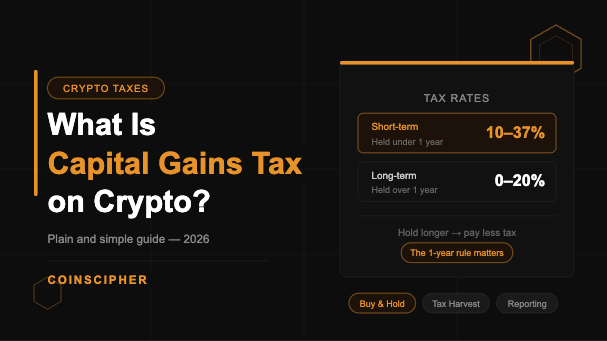
Capital gains tax on crypto is the U.S. tax on profit you make when you sell, trade, or use cryptocurrency. If you hold it for a year or less, the profit is usually taxed at ordinary income rates; if you hold it longer than a year, it is usually taxed at lower long-term capital gains rates.
A simple example: If you bought 1 ETH for $1,000 and later sold it for $1,800, your capital gain is $800. If you held it for 8 months, that $800 is usually short-term; if you held it for 14 months, it is usually long-term.
Key Takeaways
- If you hold crypto for 1 year or less, the profit is usually a short-term capital gain and is taxed at your ordinary income tax rate.
- If you hold it for more than 1 year, the profit is usually a long-term capital gain, taxed at the lower long-term rates of 0%, 15%, or 20%, depending on income.
- A taxable gain can happen not just when you sell for cash, but also when you trade one crypto for another or use crypto to buy something.
- Buying crypto is not taxable by itself; the tax usually starts when you dispose of it
- Your gain is roughly the sale price minus your cost basis; transaction fees can matter when figuring that out.
- You need good records of dates, amounts, and prices, because every taxable crypto transaction can affect your return.
- Crypto gains and losses are generally reported on Form 8949 and Schedule D.
- Losses can offset gains, and if you have more losses than gains, some losses can also offset ordinary income up to annual limits.
Practical Tip
For most U.S. taxpayers, the main question is not whether crypto is taxed, but when you disposed of it and how long you held it. Keeping clean records and separating short-term from long-term holdings is the fastest way to avoid surprises.
What Actually Triggers Capital Gains Tax on Crypto
Most new investors think they only owe tax when they cash out to their bank account. That’s wrong, and it’s the single most common mistake people make.
The IRS treats crypto as property, not currency. That one classification, established in Notice 2014-21, is why everything below applies. Because crypto is property, every time you move it out of your hands at a profit, it’s a taxable sale. Think of it like trading a painting worth $5,000 for a different painting worth $8,000. The IRS says you made $3,000 on the first one. Bitcoin, ETH, and every other token work the same way. Even if no dollars were involved.
In my experience, this is the single rule that costs new investors the most money because they simply don’t know it exists until after they’ve already traded.

With that in mind, here’s what actually triggers capital gains tax on crypto.
Selling Crypto for USD
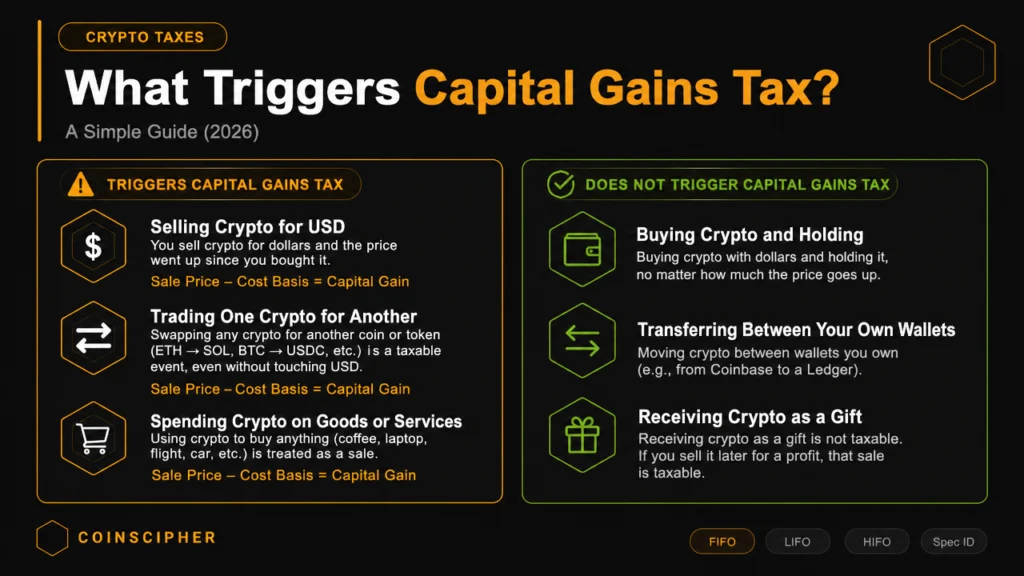
This is the obvious one. You sell Bitcoin for dollars and the price went up since you bought it. You owe tax on the profit. Here’s the formula:
Sale Price minus Cost Basis = Capital Gain
Your cost basis is what you originally paid for the crypto, including any transaction fees your exchange charged. If you bought 0.5 BTC for $15,000 and paid a $30 fee, your cost basis is $15,030.
Trading One Crypto for Another
Say you bought 2 ETH for $4,000 total. A few months later, ETH has risen, and your 2 ETH are now worth $6,500. You swap them for SOL. You might think nothing happened because you never “cashed out.” But the IRS sees it differently: you disposed of ETH at $6,500 that cost you $4,000. That’s a $2,500 capital gain.
This applies to every swap. ETH to SOL. BTC to USDC. DOGE to SHIB. The exchange doesn’t need to touch USD for the tax to apply. Every trade between tokens is a taxable event.
Spending Crypto on Goods or Services
You bought 0.1 BTC last year for $2,000. Today it’s worth $3,500 and you use it to buy a laptop. The IRS treats that purchase as a sale. You “sold” $3,500 worth of BTC that cost you $2,000. That’s a $1,500 capital gain, even though you bought a computer, not dollars.
This catches a lot of people by surprise, but when using crypto to pay for anything, whether it’s a coffee, a flight, or a car, it counts as a taxable event if the crypto has appreciated since you bought it. And yes, you’re supposed to track the gain on each purchase. Realistically, almost nobody does this manually, and that’s a problem the IRS created by treating a $4 latte the same as a $40,000 stock sale.
What Does NOT Trigger Capital Gains Tax
- Buying crypto with dollars and holding it, no matter how much the price goes up
- Transferring crypto between your own wallets (for example, moving BTC from Coinbase to a Ledger)
- Receiving crypto as a gift (but if you sell that gift later for a profit, that sale is taxable)
!Capital Gains tiggers Tax on Crypto - infographic
Short Term vs Long Term: The Rate Difference That Actually Matters
How long you hold crypto before selling it changes your tax rate dramatically. The IRS draws a hard line at 12 months.
| Holding Period | Type | Federal Rate | Notes |
| Under 1 year | Short term | 10% to 37% | Taxed like your regular income |
| Over 1 year | Long term | 0% to 20% | Most middle earners pay 15% |
Let’s see what this looks like with real numbers.
Short-term example
You bought Bitcoin for $20,000. Eight months later you sold it for $35,000. That’s a $15,000 short term gain. Because you held it for under a year, it’s taxed at your regular income rate, anywhere from 10% to 37% depending on your tax bracket. If you’re in the 24% bracket, that’s $3,600 owed on that single trade.
Long-term example
You bought ETH for $2,000. Fourteen months later you sold it for $5,000. That’s a $3,000 long term gain. For most people earning a middle income, the rate is 15%. So you’d owe about $450, not thousands.
These are federal rates only, which means state taxes may apply. Your situation may differ, so always speak to a tax professional before making any decision.
Two facts worth remembering:
- If you’re a single filer earning under $48,350/year, your long term capital gains rate is 0%. You read that right. Zero.
- The 12 month holding line is the most important date on your crypto calendar. Crossing it can cut your tax rate in half or more. And yet, most new investors blow right past it because they panic sell at month eight or nine when the price dips. If you can hold your nerve for a few more weeks, the tax savings alone can be worth thousands.
How to Calculate Your Crypto Capital Gain
You don’t need an accounting degree for this, here’s the 3-step formula:
- Step 1: Find your cost basis. That’s what you paid for the crypto, plus any fees. If you bought 1 ETH for $3,200 and your exchange charged a $10 fee, your cost basis is $3,210.
- Step 2: Find your proceeds. That’s what you received when you sold, traded, or spent it. If you sold that 1 ETH for $4,800, your proceeds are $4,800 (minus any selling fees).
- Step 3: Subtract. Proceeds minus cost basis equals your capital gain (or loss). $4,800 minus $3,210 = $1,590 capital gain
That’s all there is to it for a single trade. But here’s where it gets complicated: if you bought the same crypto in multiple batches at different prices, you need to decide which batch you’re “selling.” The IRS allows several methods (FIFO, LIFO, specific identification), and the one you choose can change your tax bill. FIFO, which stands for first in first out, is the most common and the default most exchanges use.
Now multiply that across dozens or hundreds of trades on Coinbase, Binance, and Robinhood over the past year. Calculating cost basis manually for every single transaction becomes a real headache. I’ve seen people overpay by thousands simply because they couldn’t prove what they originally paid for a coin they bought eleven months ago on a different exchange. That’s exactly why tools like Koinly and CoinTracker exist. They connect to your exchanges, import your full transaction history, and calculate everything for you. If you’ve made more than a handful of trades, they’re worth looking into.
CoinTracker — coincipher.com
CoinTracker
Best for US users and simple portfolios
Designed for simplicity — especially if you’re US-based and want a smooth, guided experience with strong integrations like TurboTax.
★ ★ ★ ★ ★ 4.6 / 5
Best for
US investors wanting a simple, hands-off experience
What it feels like
Connect accounts, track portfolio, export to TurboTax
Why it stands out
- Seamless TurboTax integration for US tax filing
- Clean, beginner-friendly interface and strong mobile app
- Real-time portfolio tracking year-round
- Covers multiple tax years under one plan
- Reliable syncing for major chains (ETH, Solana, etc.)
What to consider
- Higher pricing as transaction volume grows
- Limited customization for non-US tax rules
- Fewer wallet and blockchain integrations vs Koinly
Start with CoinTracker Built for easy US tax filing
The Form 1099-DA (New in 2026)
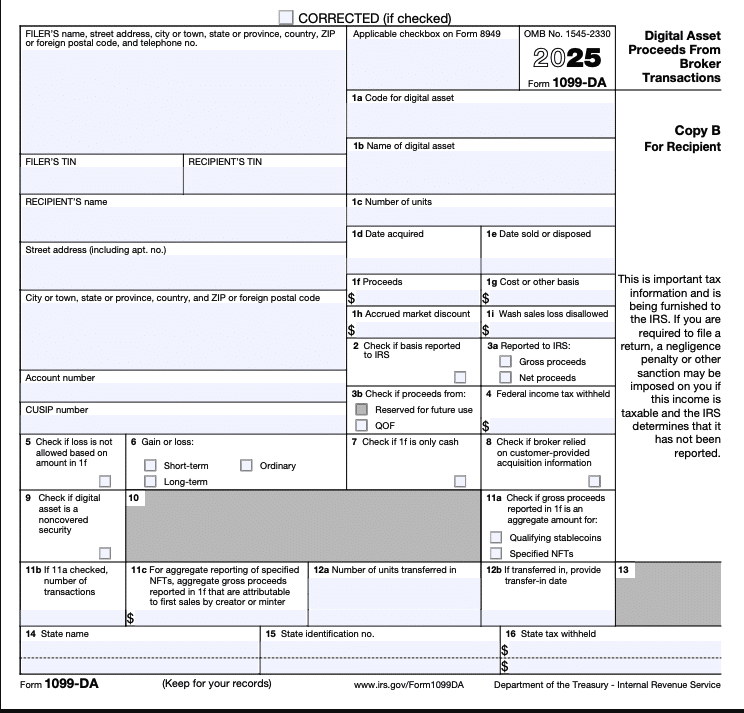
Form 1099-DA is a new IRS form that crypto exchanges are now required to send to you and directly to the IRS. It reports the sale proceeds from every crypto transaction you made on that exchange. Coinbase, Kraken, Binance US, Robinhood. They all must issue it now.
Here are the key insights you need to know:
- What it means for you: The IRS now has a record of your trades, whether you report them or not. If you were thinking, “maybe I just won’t mention my crypto,” that’s no longer a realistic option. The data is already on their desk.
- Here’s my honest take on this: The 1099-DA is actually good news for people who are trying to do the right thing. Before this form existed, honest investors were playing by the rules while others quietly ignored their crypto gains. Now everyone is on the same playing field. The IRS built the enforcement infrastructure before most people even understood the rules, and that feels backwards, but it is what it is.
- The catch for 2025 transactions: Exchanges report your _proceeds_ (what you sold for) but not your cost basis yet. That means you still need your own records to calculate the actual gain. Don’t rely on the 1099-DA alone to file accurately. It only tells half the story.
- What changes in 2027: Starting with 2026 transactions, full cost basis reporting becomes mandatory. Exchanges will report both what you sold for and what you originally paid. That makes your calculations simpler but also gives the IRS a complete picture of every trade.
- For European readers: A parallel framework called CARF (the OECD’s Crypto-Asset Reporting Framework) entered into force on January 1, 2026. Participating exchanges across Europe and beyond are now collecting transaction data that will be shared between tax authorities starting in 2027. If you’re based in the EU, your local tax authority is likely already receiving data from your exchange.
- What should you do right now? Download your transaction history from every exchange you’ve used. Even if you’re not filing yet, having a complete record of your trades, dates, and prices is the single most important step you can take. If the 1099-DA shows the IRS your proceeds and you can’t prove your cost basis, you could end up paying tax on the entire sale amount, not just the profit.
Frequently Asked Questions
Do I Pay Capital Gains Tax if I Trade One Crypto for Another?
Yes. Every trade between cryptocurrencies is a taxable event, just like selling for cash. When you swap ETH for SOL, you’re disposing of ETH. If its value went up since you bought it, you owe tax on that gain. The fact that no dollars changed hands doesn’t matter to the IRS.
Is Holding Crypto Taxable?
No. You can buy crypto, hold it for years, and watch it multiply in value. You won’t owe a cent until you sell, trade, or spend it. Tax only kicks in when you dispose of it.
What’s the Difference Between Short Term and Long Term Capital Gains on Crypto?
If you held the crypto for under 12 months before selling, the gain is short term and taxed at your regular income rate (10% to 37%). If you held it over 12 months, the gain is long term and taxed at a lower rate (0% to 20%). Holding for over a year is one of the simplest ways to reduce your crypto tax bill.
How Do I Calculate My Crypto Capital Gain?
Subtract your cost basis (what you originally paid, including fees) from your sale proceeds. The result is your capital gain. If the number is negative, you have a capital loss, which can offset other gains or up to $3,000 of regular income per year.
What happens if I lose money on Crypto? Do I Still Need to Report It?
Yes, and you should. Capital losses can offset your gains, reducing what you owe. If your losses exceed your gains, you can deduct up to $3,000 of net loss against your regular income each year, and carry any remaining loss forward to future years. You report these on Form 8949 and Schedule D.
What Is Form 1099-DA?
Form 1099-DA is a new IRS form that crypto exchanges must issue starting in 2026. It reports the sale proceeds from your crypto transactions both to you and directly to the IRS. For 2025 trades, it covers proceeds only (not cost basis). Starting with 2026 trades, exchanges will report both proceeds and cost basis.
Do I Owe Tax on Staking Rewards?
Yes. Crypto received from staking is taxed as ordinary income at the fair market value on the day you received it. It’s not a capital gain at that point. It’s income, like a paycheck. Later, if you sell or trade those staked tokens and they’ve gone up in value since you received them, that _second_ event triggers capital gains tax.
How Do I Avoid Capital Gains Tax on Crypto Legally?
You can’t eliminate it entirely, but you can reduce it significantly: Hold for over 12 months. This shifts you from short term rates (up to 37%) to long term rates (0% to 20%). Harvest your losses. Sell crypto that’s dropped in value to offset gains and reduce taxable income by up to $3,000 per year. Use a tax advantaged account. Some self directed IRAs allow crypto investments where gains grow tax free (Roth) or tax deferred (Traditional). Donate crypto to charity. Donating appreciated crypto to a qualified charity avoids capital gains tax entirely and may be deductible. Gift strategically. You can gift up to $18,000 per person per year (2024 limit) without triggering gift tax.
Bottom Line
Capital gains tax on crypto is real, it applies to more situations than most people think, and 2026 is the year it becomes much harder to ignore. Exchanges now report your trades directly to the IRS through Form 1099-DA. If you’ve sold, swapped, or spent crypto at a profit, you owe tax on it.
Here’s your quick action list: download your transaction history from every exchange you’ve used. Figure out your cost basis for each trade. Consider crypto tax software if you’ve made more than a handful of trades. Hold for over 12 months when you can to get the lower long term rate. And before you file, talk to a tax professional who understands crypto, especially if this is your first year reporting. The IRS is paying attention now, and they have the receipts.
Related reading
September 14, 2026
September 14, 2026
September 14, 2026
September 14, 2026
More in Crypto Tax Hub
- [How to File Metamask Tax Documents: A Comprehensive Guide
23 hr ago](/crypto-tax/metamask-tax-documents/)
- [Does KuCoin Report To The IRS? – CoinsCipher – Cryptocurrencies Analysis, Guides, and Research
1 day ago](/crypto-tax/does-kucoin-report-to-the-irs/)
- [Does Metamask report to the IRS? Here Is What We Know
1 day ago](/crypto-tax/does-metamask-report-to-the-irs/)
- Does Binance Report To The IRS? Explained 1 day ago
- [Does Crypto.com Report To The IRS?
1 day ago](/crypto-tax/does-crypto-com-report-to-the-irs/)
Top gainers 24h
- Loading market data...
Top losers 24h
- Loading market data...
Make sense of crypto.
Weekly analysis. No hype, no jargon. Free.