What is Cost Basis in Crypto? How to Calculate It and Reduce Your Taxes
The cost basis is what you actually paid for crypto, including fees and commissions. It is the number used to calculate your real profit or loss for taxes.
Key takeaways
Calculating your cost basis includes finding the original purchase price and adding all acquisition-related fees.
Your final tax result changes completely depending on whether you choose FIFO, LIFO, or HIFO to identify which crypto you are selling.
The realized price is a psychological “break-even” line for the entire market, helping you distinguish between healthy pullbacks and major market bottoms.
How much did you actually pay for your last crypto purchase? Most people focus on the price they see on the screen and ignore fees, which is why their profit often doesn’t match what they expect. If you bought the same crypto multiple times, it gets even more confusing because there isn’t just one buy price.
The Meaning of Cost Basis in Crypto
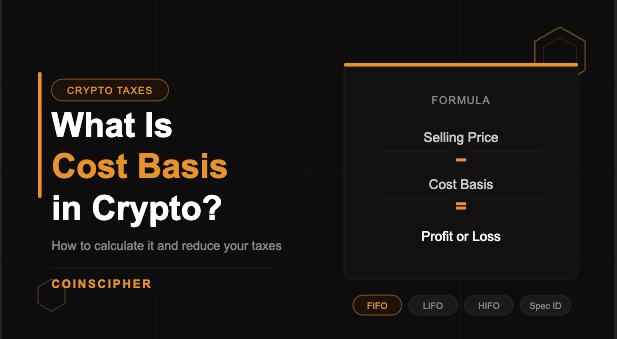
Cost basis in crypto is the total amount you actually paid to get your crypto, including fees and commissions. It’s the number you use to calculate your real profit or loss when you sell, trade, or use it, and that result is what determines how much tax you may owe. You calculate it using: Selling Price – Cost Basis = Profit or Loss.
In my experience, your cost basis isn’t always tied to a single purchase. If you buy the same crypto multiple times, your cost basis comes from all those purchases plus fees. This becomes your reference point for every future sale.
Here are three ETH purchases that I made a while back.
- January 2024: I bought ETH worth $20,000 at Coinbase. The exchange charged me a $75 fee.
- March 2024: I bought another ETH worth $50,000 on the same exchange for a fee of $250.
- June 2024: I bought ETH at $30,000. The fee was $100.
By June 16th, I had spent $100,000 on ETH. However, my total spent was $100,425 because it included the $425 in fees. These fees become part of my cost basis and reduce my taxable profit when I sell.
What is Crypto Cost Basis?
Your cost basis is the total amount you pay to own crypto, including fees. Every time you sell or trade, the difference between your cost basis and the current value is your taxable gain or loss.
If I move 0.5 ETH from Coinbase to my Ledger, I usually pay a gas fee (a network fee for the transfer). When I trade the ETH for Tron on PancakeSwap, I pay another fee. The transfer and swap costs become part of Tron’s cost basis.
Why is Crypto Basis Important for Crypto Taxes

Your cost basis matters because it determines how much tax you owe. It is the number your tax authority uses to measure your real profit whenever you sell, swap, or spend crypto. If the cost basis is too low or missing, your profits appear bigger than they are, and you end up reporting higher gains than actual. On the flip side, if the crypto basis looks inaccurate, you are likely to be flagged for an audit by your tax authority. You should track your crypto movement across DeFi, exchanges, and wallets so that you only pay taxes on your true gains.
Here are things to keep in mind about cost basis.
Capital Gains Calculation: Use the capital gains calculator, and if you find that you sell for more than your cost basis, you have a taxable gain. However, when you sell for less, you have a loss that may reduce your taxes.
Determining Tax Liability: You can overpay taxes or report incorrect numbers if you don’t have a correct cost basis, which may lead to issues with tax authorities.
Methodology Matters: The way you calculate cost basis in crypto affects your final tax bill. Common methods include FIFO (selling the oldest crypto first) and specific identification (choosing exactly which crypto you sell).
Short vs. Long Term: Your cost basis is used to calculate gains, which are then classified as short-term (under 1 year) or long-term (over 1 year). This directly impacts the tax rate you pay. The tax rate ranges from 0% to 37% depending on income and holding period.
How to Calculate Crypto Cost Basis (Step-by-Step)
You can calculate your crypto basis for any crypto swaps and sales you carried out throughout the year using the four steps below.
Step 1: Add up the total amount paid for the crypto.
Find the market value at the time you bought the crypto. If you purchased the coins with cash, this is your purchase price. However, if you got it through a trade, use the value at the time of the swap.
Step 2: Include all fees and commissions.
Add exchange commissions, broker fees, and blockchain gas fees to your purchase price.
Step 3: Match the sale to a specific purchase.
Since you likely bought the same coins at various prices, choose which specific crypto you will be selling.
Step 4: Subtract the cost basis from the selling price.
The resulting figure is your capital gain or loss. It is the number you need for your tax reporting.
Let’s calculate the cost basis for my ETH buy and sell that I discussed earlier.
If I sell ETH worth $30,000 in December, the exchange may charge a selling fee (let’s say $150). Here’s the breakdown:
Sale Value: $30,000
Selling Fee: $150
Net Proceeds: $29,850 ($30,000 – $150)
Next, match this to a specific purchase using Step 3. If I choose to sell the ETH lot I bought in January (using FIFO)
Original Purchase Price: $20,000
Original Buy Fee: $75
Cost Basis for this portion of ETH: $20,075
Taxable Gain: $29,850 – $20,075 = $9,775
I recommend using crypto tax software like Koinly to automate this. These platforms allow you to choose your preferred cost basis method, connect your wallets, and let the software do the math for you. This simplifies the calculations, especially if you have multiple trades throughout the year.
An Overview of Crypto Tax Methods
When you have multiple buy orders for the same crypto, your “true” price depends on the method you use to get the cost basis. I use these four standard methods to determine which coins I am selling before filing crypto taxes.
FIFO (First-In, First-Out)
With FIFO, you sell your oldest crypto first. This is the most commonly used method and is often the default for most exchanges. If I bought Bitcoin in 2017 and 2021, FIFO assumes I am selling the 2017 coins today. This usually leads to the highest taxes. I use FIFO when I want to qualify for long-term capital gains rates after holding my crypto for over a year.
LIFO (Last-In, First-Out)
I use LIFO when I want to reduce short-term gains without touching older crypto. Here, I sell my most recently purchased crypto first. I find this useful if I recently bought at a high price and want to realize a loss to offset other gains. Essentially, I am selling the most expensive coins to shield my other profits from being taxed.
Specific Identification (Spec ID)
Spec ID allows me to choose exactly which coins I am selling. For example, I can point to a specific transaction and say, “I am selling these exact coins I bought last Tuesday.” It requires me to keep a record of every wallet address and transaction hash. I use Spec ID when I want full control over which gains or losses I realize.
HIFO (Highest-In, First-Out)
HIFO is a type of Spec ID where I sell the most expensive coins first. I use this method to reduce taxable gains as much as possible, as it gives me the lowest “profit” on paper. The method defers my tax burden to a later date, giving me more flexibility to grow my portfolio today.
!cost basic method meaning and when to pick them

How Each Method Works with Real Calculations
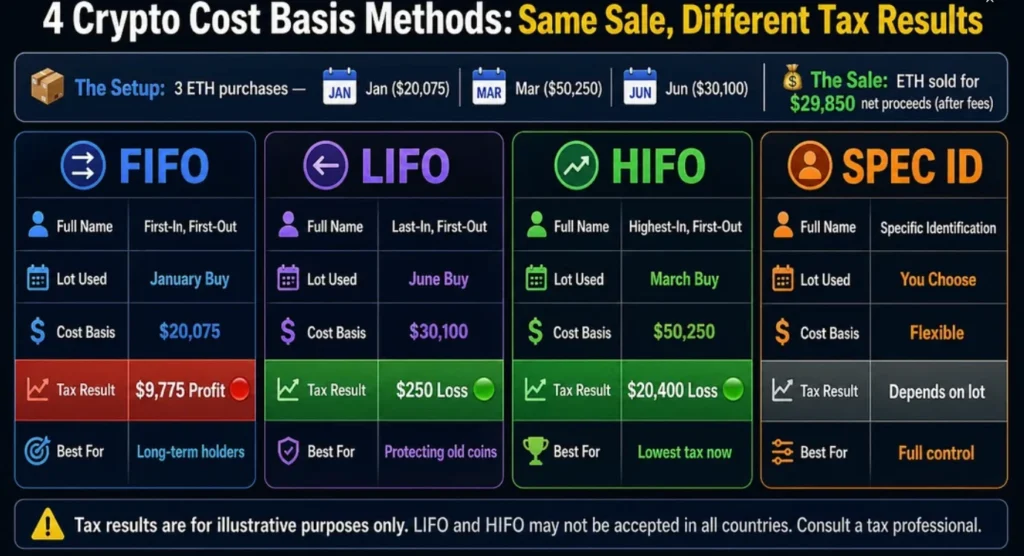
I can have completely different tax results depending on the method that I pick. Using our example, I sold ETH for $30,000 in December 2025. After a $150 selling fee, my net proceeds are $29,850.
My cost basis in crypto depends entirely on the method I pick. Here’s how I calculate the taxes with every method across my three buys.
| Method | Lot Used | Cost Basis (Price + Fee) | Calculation | Taxable Result |
| FIFO | January Buy | $20,075 | $29,850 – $20,075 | $9,775 Profit |
| LIFO | June Buy | $30,100 | $29,850 – $30,100 | $250 Loss |
| HIFO | March Buy | $50,250 | $29,850 – $50,250 | $20,400 Loss |
Why HIFO is my favorite strategy
HIFO enables me to immediately reduce taxable gains. In the table above, selecting the March lot results in a $20,400 loss on paper. This is a tax calculation, not an actual loss. I sold the “expensive” coin first to cancel out gains from other coins, reducing my taxable gains for that year.
When I choose FIFO
With FIFO, I can qualify for long-term capital gains rates after holding crypto for a year. In many countries, holding crypto for 12 months or more drops the tax rate significantly. In the case above, I may actually pay a lower rate (15% to 20%) despite having the highest taxable profit.
When to use LIFO
LIFO allows me to minimize my immediate taxable gains without using my older, lower-priced crypto. In our Bitcoin example, selling the June lot instead of the January one reduces the reportable profit. This approach is effective when I want to keep my long-term crypto untouched while utilizing more recent, higher-priced entries to offset my current tax liability.
Spec ID Gives Me the Freedom to Choose
With Specific Identification (Spec ID), I choose exactly which Bitcoin I am selling from my three purchases. I have the freedom to decide what to sell based on the expected capital gains.
For example, if I pick the March buy ($50,000 + $250 fee = $50,250), I report a $20,400 loss. However, if I pick the January buy ($20,000 + $75 fee = $20,075), I report a $9,775 profit. The result depends entirely on which lot I select.
!Real cost basis calculations of 3 eth purchases
Long-Term Holder Realized Price (LTH): The Average Cost Basis
The “realized price” is the average price that all coins in the market were last bought at. Think of it as the market’s true break-even level. For example, if one person bought Bitcoin at $20,000 and another bought at $40,000, the realized price sits somewhere in between. When you scale this across millions of coins, you get the average cost basis for the entire market.
While the daily market price tells you what the coins are worth right now, the realized price informs you the average price at which every coin in circulation was last moved. Because of this, realized price can be your reference line between profit and loss:
- If the price is above it, you are in profit.
- If the price is below it, you are at a loss.
I will use Bitcoin’s current average cost and price graph to explain the impact of LTH on buy/sell decisions.
The Bitcoin Realized Price Comparison
_Source: Newhedge_
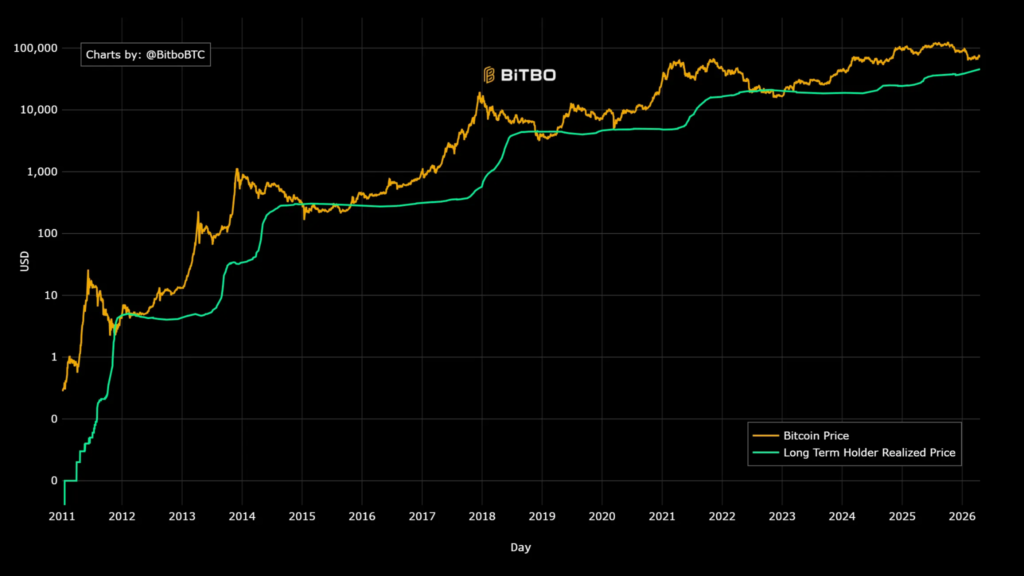
This chart shows the line between a market that is making a gain and one that is under extreme pressure. Here is what we can deduce from the above chart.
When the Market Price is Above or Below the Realized Price
In the chart above, the realized price is the yellow line, which is currently around $76,800. It is the average cost basis for newer investors across the market. This means they make a profit when the price moves higher and a loss when the price dips. If the price had dipped lower and returned to slightly above the amount, many would see it as a chance to get out without losing money.
Because a lot of people think this way, selling tends to increase around that price. For a while, there can be more sellers than buyers, which makes it harder for the price to move higher. So, that’s why this level often acts like resistance, at least in the short term.
When The Market Price Is At The Long-Term Holder (LTH) Realized Price
The green line is the Long-Term Holder (LTH) realized price. This line tracks the average price long-term holders (over 155 days) paid for their Bitcoin. From the chart above, you realize that the price is much lower than the realized price at about $45,300. At this level, those who held their Bitcoins over an extended period usually have a much lower cost basis, so they are still in profit even when the average price takes a dip. Many are less likely to sell, which reduces selling pressure. However, the average investor is at a loss at this price point.
What Does It Mean for Your Buy/Sell Decisions?
Both lines on the chart show the average cost basis for new (yellow line) and long-term (green line) investors. If you are a new investor, when the price stays above $76,800, it means that any gains are a profit. However, if it fails to break that $76,800 line, it suggests the market is cooling down. Make selling decisions based on your cost basis relative to market price and tax strategy.
The case is different if you have held the coin for over 155 days. You can wait for the price to go higher, as your cost basis is much lower.
Tools to Automate Crypto Cost Basis Calculation for Tax Reporting
Tracking thousands of crypto trades across DeFi protocols, centralized exchanges, and hardware wallets is impossible to do by hand. There is a high chance that you will make mistakes when entering figures from diverse crypto events. I recommend that you use crypto tax software to handle the calculation for you.
What Is Crypto Tax Software?
Crypto tax software like Koinly or CoinTracker is a tool that connects directly to your exchange accounts and blockchain wallets. They then perform a reconciliation of your data. This means they look at every crypto “in” and “out” and match them together for your tax filing.
They handle the “Zero-Basis Trap.”
If I move 1 BTC from Coinbase to my Ledger, Coinbase thinks I sold it. My software knows it was just a transfer, so zero-basis trap. It keeps my original cost basis in crypto attached to that Bitcoin for tax purposes.
They generate legal reports.
These tools generate tax forms (like Form 8949 in the US) that you can send to your accountant or upload to tax software. This makes tax filing less taxing and reduces mistakes common in copying and pasting.
They provide real-time tracking.
I can see my “unrealized” gains throughout the year, which helps me decide if I should sell a specific coin to harvest a tax loss before December 31st. If you are a high-volume trader looking to profit from your trades, tracking can help you cut taxes and make strategic moves on time.
FAQs
Are crypto fees included in the cost basis?
Yes. Always include exchange fees, brokerage commissions, and blockchain gas fees. These costs increase your cost basis, which directly reduces your taxable profit. Keep a record of each of these costs across various transactions for accurate reconciliation.
How do you calculate cost basis in crypto?
I use the formula (purchase price of coins + transaction fees) / quantity of coins. If I spent $4,000 on 2 ETH and paid a $20 fee, my cost basis is $4,020 total, or $2,010 per ETH.
Is crypto-to-crypto trading taxable?
Yes, swapping crypto counts as selling. You must report the gain or loss from the transaction.
What triggers a taxable event in crypto?
Taxable events include selling crypto for fiat, swapping for another coin, spending crypto on a coffee, or receiving coins as income (mining/staking).
Which cost basis method is best for crypto?
I find HIFO best for saving money now. However, FIFO is the safest for ensuring I qualify for long-term capital gains rates.
What happens if you don’t know your cost basis?
You might be forced to use a $0 basis, which means that you pay taxes on the total value of the sale. I always suggest checking old emails or block explorers to find the original price.
Do you pay tax if you don’t convert crypto to cash?
Yes, any swap or trade is a taxable event, regardless of whether you moved the money to a bank account. This is because you disposed of some crypto and realized a gain or loss. Any gain is taxable. However, if you are simply holding the initial crypto you purchased, there is no taxable event, even if its value increases over time.
Is transferring crypto between wallets taxable?
No. Moving funds between your own wallets is a non-taxable event, though you can usually add the transfer fee to your cost basis.
What does cost basis tell you?
It tells me exactly how much I need to sell so as not to make a loss. It is my true break-even point.
What are the common cost basis calculation methods?
The big four are FIFO (oldest first), LIFO (newest first), Spec ID (you choose), and HIFO (most expensive first). Each determines what crypto you pick and sell to determine a loss or profit. Always pick a method that lowers your tax bill calculations.
Conclusion
Understanding cost basis helps you track real profit and tax correctly. From my experience moving funds across various chains, I know how easy it is to lose track of those crypto purchases. However, taking the time to track and reconcile my data helps me avoid common mistakes. I recommend using tax software for tracking, reconciling, and generating reports, especially if you have many tax events.
References
Bitcoin Long Term Holder Realized Price — Newhedge
Frequently Asked Questions on Virtual Currency Transactions — IRS
This Rarely Used Tax Loophole is Helping Some Bitcoin Holders Save Tons of Cash — CNBC
Understanding Crypto Taxes — Coinbase
Related reading
September 14, 2026
September 14, 2026
September 14, 2026
September 14, 2026
More in Crypto Tax Hub
- [How to File Metamask Tax Documents: A Comprehensive Guide
21 hr ago](/crypto-tax/metamask-tax-documents/)
- [Does KuCoin Report To The IRS? – CoinsCipher – Cryptocurrencies Analysis, Guides, and Research
23 hr ago](/crypto-tax/does-kucoin-report-to-the-irs/)
- [Does Metamask report to the IRS? Here Is What We Know
23 hr ago](/crypto-tax/does-metamask-report-to-the-irs/)
- Does Binance Report To The IRS? Explained 23 hr ago
- [Does Crypto.com Report To The IRS?
23 hr ago](/crypto-tax/does-crypto-com-report-to-the-irs/)
Top gainers 24h
- Loading market data...
Top losers 24h
- Loading market data...
Make sense of crypto.
Weekly analysis. No hype, no jargon. Free.