

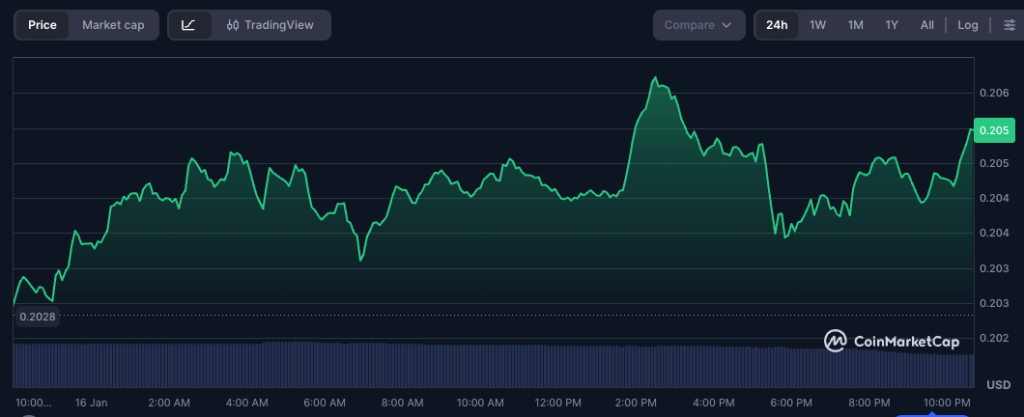
Pi Network has moved from a long experiment into an actively traded crypto, As of January 16, Pi (PI) is trading at around $0.2054, putting it far below early expectations but firmly on the market map. Looking ahead, market forecasts suggest Pi could trade in the $0.45 to $0.65 range by 2028 if adoption continues to grow. By 2030, longer term projections place Pi closer to $0.80 to $1.20, assuming broader usage, exchange support, and favorable market conditions.
Key takeaways
- Pi’s price outlook remains highly sensitive to utility growth, token circulation changes, and broader crypto market cycles.
- Pi Network is trading around $0.2054 in 2026, according to current CoinMarketCap data.
- Short to mid term projections suggest Pi could move into the $0.45–$0.65 range by 2028 if adoption and ecosystem activity continue to expand.
- Longer term forecasts for 2030 place Pi between $0.80 and $1.20, depending on real world use cases, exchange availability, and overall market conditions.
Pi (PI) Technical Analysis
As of January 16, 2026, Pi Network is trading near $0.205, and recent price action shows the market trying to stabilize around this level. Buyers have consistently stepped in just above $0.19–$0.20, which has acted as a short term support zone, while selling pressure tends to appear closer to the $0.23–$0.25 range.
From a trend perspective, Pi’s longer term moving averages are beginning to flatten after a prolonged decline, suggesting the sharp downside momentum has eased. Shorter term averages are slowly turning upward, a sign that buyers are regaining some control, though the trend is still cautious rather than aggressive.
Momentum indicators also reflect this balance. The Relative Strength Index (RSI) is sitting near the middle of its range, showing neither overbought nor oversold conditions. In simple terms, the market is waiting for a clear catalyst before making a strong move in either direction.
On the fundamentals side, Pi Network continues to benefit from a large user base and ongoing ecosystem development. While adoption alone does not guarantee price gains, steady network activity helps support long term value and reduces the risk of sharp breakdowns at current levels.
Bull vs Bear Scenario for Pi Network
- Bull case: If Pi maintains support above $0.20 and network usage continues to grow, a breakout above $0.25 could open the door toward the $0.30–$0.35 range. This scenario depends on stronger adoption, broader exchange access, and a supportive crypto market.
- Bear case: If buying interest weakens and Pi falls below $0.19, downside pressure could push the price toward $0.16–$0.17. In this case, the market would likely remain range-bound until new demand or utility appears.
Pi (PI) price prediction 2026
| Month | Minimum Price | Average Price | Maximum Price |
|---|---|---|---|
| January 2028 | $0.247 | $0.300 | $0.353 |
| February 2028 | $0.247 | $0.300 | $0.353 |
| March 2028 | $0.247 | $0.300 | $0.353 |
| April 2028 | $0.247 | $0.300 | $0.353 |
| May 2028 | $0.247 | $0.300 | $0.353 |
| June 2028 | $0.247 | $0.300 | $0.353 |
| July 2028 | $0.247 | $0.300 | $0.353 |
| August 2028 | $0.247 | $0.300 | $0.353 |
| September 2028 | $0.247 | $0.300 | $0.353 |
| October 2028 | $0.247 | $0.300 | $0.353 |
| November 2028 | $0.247 | $0.300 | $0.353 |
| December 2028 | $0.247 | $0.300 | $0.353 |
Pi (PI) price prediction 2028
| Month | Minimum Price | Average Price | Maximum Price |
|---|---|---|---|
| January 2028 | $0.247 | $0.300 | $0.353 |
| February 2028 | $0.247 | $0.300 | $0.353 |
| March 2028 | $0.247 | $0.300 | $0.353 |
| April 2028 | $0.247 | $0.300 | $0.353 |
| May 2028 | $0.247 | $0.300 | $0.353 |
| June 2028 | $0.247 | $0.300 | $0.353 |
| July 2028 | $0.247 | $0.300 | $0.353 |
| August 2028 | $0.247 | $0.300 | $0.353 |
| September 2028 | $0.247 | $0.300 | $0.353 |
| October 2028 | $0.247 | $0.300 | $0.353 |
| November 2028 | $0.247 | $0.300 | $0.353 |
| December 2028 | $0.247 | $0.300 | $0.353 |
Pi (PI) price prediction 2030
| Month | Minimum Price | Average Price | Maximum Price |
|---|---|---|---|
| January 2030 | $0.380 | $0.480 | $0.580 |
| February 2030 | $0.380 | $0.480 | $0.580 |
| March 2030 | $0.380 | $0.480 | $0.580 |
| April 2030 | $0.380 | $0.480 | $0.580 |
| May 2030 | $0.380 | $0.480 | $0.580 |
| June 2030 | $0.380 | $0.480 | $0.580 |
| July 2030 | $0.380 | $0.480 | $0.580 |
| August 2030 | $0.380 | $0.480 | $0.580 |
| September 2030 | $0.380 | $0.480 | $0.580 |
| October 2030 | $0.380 | $0.480 | $0.580 |
| November 2030 | $0.380 | $0.480 | $0.580 |
| December 2030 | $0.380 | $0.480 | $0.580 |
We focus on giving readers clear, useful crypto coverage without hype. Based on our review of Pi Network in 2026, the project still stands out for one main reason: scale. Few crypto projects have attracted as many users before reaching full market maturity, and Pi’s mobile-first approach helped it build that audience early.
Pi Network’s move from an experiment into a traded asset puts it in a new phase. The price has not lived up to early expectations, but it has found a place in the market and continues to hold attention. That matters. Price action, trading activity, and ongoing development suggest Pi is no longer just a concept — it’s a live crypto that now has to prove itself.
From a technical point of view, Pi’s chart shows clear support and resistance levels, which helps traders understand where buyers and sellers are active. Momentum indicators point to a market that is cautious but not abandoned. That leaves room for upside if adoption grows, and downside if interest fades.
Pi Network is trying to make crypto easier to access, and that goal is still relevant. Whether it succeeds long term will depend on real usage, transparency, exchange availability, and how well the team delivers on its roadmap — not on promises alone.
As always, crypto prices can move fast in both directions. Anyone following Pi should watch market data closely, rely on trusted sources, and avoid treating forecasts as guarantees.
CoinsCipher will continue tracking Pi Network with clear data, real context, and updates as the story develops.
FAQs
How much will Pi be worth in 2026?
Pi Network is forecasted to trade roughly between about $0.14 and $0.20 in 2026 according to aggregated price forecasts, with the average near the lower end of that range. These are model-based estimates, not guarantees, and assume the network’s adoption grows steadily.
Can Pi reach $10?
Reaching $10 per token would require a very large increase in market value. Some long-term models suggest Pi could eventually reach prices in the single-digit range under strong adoption, but established forecast algorithms generally do not see Pi hitting $10 by 2030 in normal scenarios. In fact, reaching $10 would require thousands of percent growth.
Will Pi Coin reach $500?
No authoritative forecast from reliable market sources predicts Pi Network reaching $500 by 2030. Hitting that level would require extremely outsized adoption and capital inflows far beyond what current models assume — something most forecasting tools do not expect.
Can Pi reach $5?
Some long-term forecasts, especially those that model broader adoption and full network utility, do consider the possibility of Pi trading in the low single-digit range by the late 2020s (e.g., around $1–$5). However, these outcomes are speculative and depend heavily on real-world usage, exchange listings, and sustained demand. No major forecasting site guarantees $5.
Which coin will 100x in 2026?
No specific crypto can be confidently predicted to 100x by 2026 according to authoritative price sources. A 100x move requires extraordinary market conditions and typically involves very low-price, low-market-cap tokens. Established forecasting data does not single out Pi or any major listed crypto as a guaranteed 100x candidate within this period.
Does Pi keep going forever?
Pi Network’s price history shows it has continued trading since mainnet launch, but no crypto runs forever without changes. Pi will continue to trade as long as there is a market and active adoption, but future price movement depends on real usage, development progress, and investor confidence — not on longevity alone. Markets can remain sideways, rise, or fall depending on broader conditions