


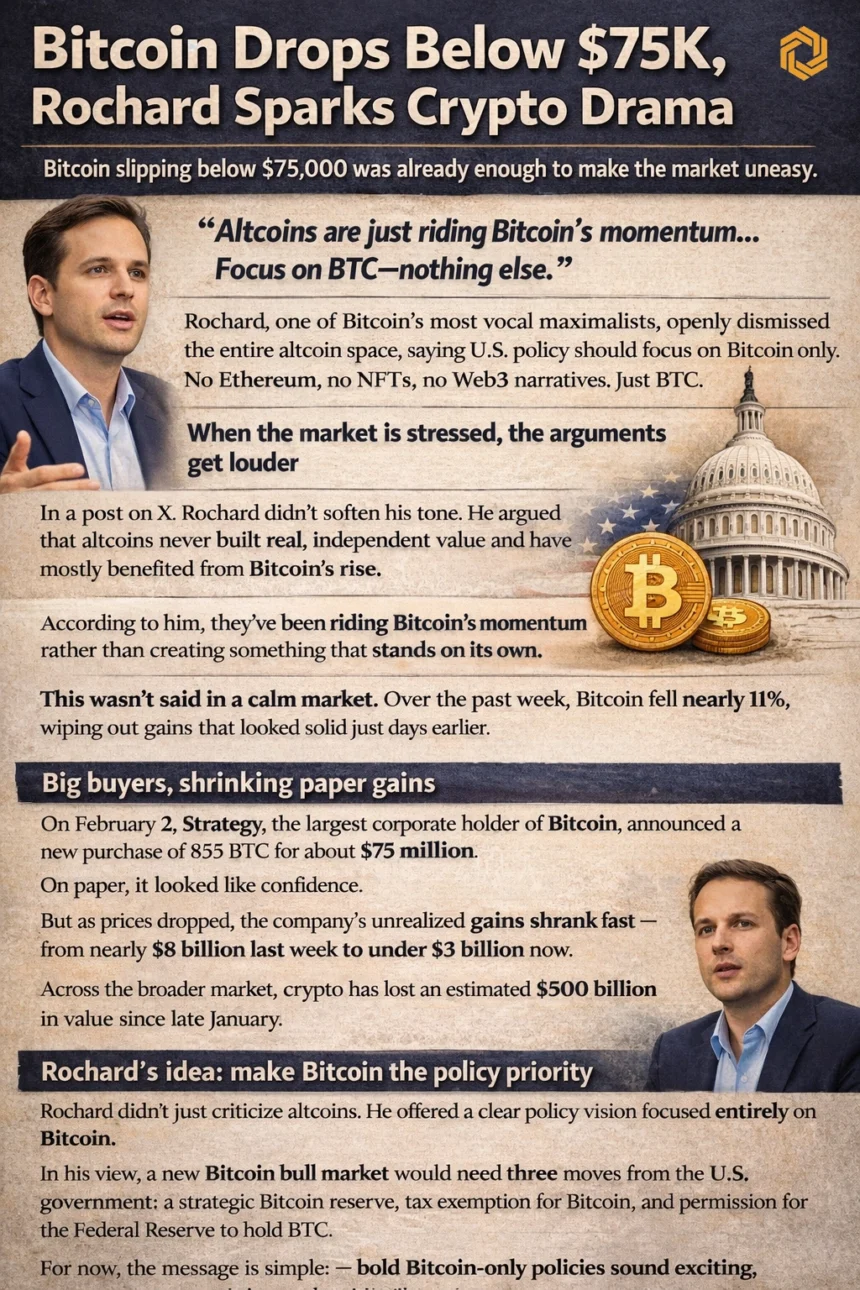
Rochard, one of Bitcoin’s most vocal maximalists, openly dismissed the entire altcoin space, saying U.S. policy should focus on Bitcoin only. No Ethereum, no NFTs, no Web3 narratives. Just BTC.
The timing mattered. His comments came during a broad market sell-off, with investors nervous about macro pressure and ongoing regulatory uncertainty in Washington.
When the market is stressed, the arguments get louder
In a post on X, Rochard didn’t soften his tone. He argued that altcoins never built real, independent value and have mostly benefited from Bitcoin’s rise.
According to him, they’ve been riding Bitcoin’s momentum rather than creating something that stands on its own.
This wasn’t said in a calm market. Over the past week, Bitcoin fell nearly 11%, wiping out gains that looked solid just days earlier.
Even large corporate holders felt the hit.
Big buyers, shrinking paper gains
On February 2, Strategy, the largest corporate holder of Bitcoin, announced a new purchase of 855 BTC for about $75 million. On paper, it looked like confidence.
But as prices dropped, the company’s unrealized gains shrank fast — from nearly $8 billion last week to under $3 billion now.
Across the broader market, crypto has lost an estimated $500 billion in value since late January.
That backdrop matters when bold opinions start flying.
Rochard’s idea: make Bitcoin the policy priority
Rochard didn’t just criticize altcoins. He offered a clear policy vision focused entirely on Bitcoin.
In his view, a new Bitcoin bull market would need three moves from the U.S. government:
a strategic Bitcoin reserve, tax exemption for Bitcoin, and permission for the Federal Reserve to hold BTC.
The reaction online was mixed. Some users pointed out the irony — suddenly Bitcoin should be treated like real money, especially when taxes are involved.
Rochard pushed back, saying Bitcoin isn’t a foreign currency and shouldn’t be taxed that way at all.
Washington is focused on something else
The problem is that U.S. policymakers are looking in a different direction.
On February 2, representatives from major crypto companies and traditional banks met at the White House to discuss stablecoin yield regulation. This issue remains one of the main obstacles blocking progress on the CLARITY Act in the Senate.
Rochard criticized that focus, calling stablecoin yield a distraction. From his perspective, Bitcoin tax policy and a strategic reserve should come first.
The bigger picture: pressure everywhere
The current environment isn’t helping anyone’s narrative.
This isn’t just a crypto issue. Commodities and equities have also seen sell-offs. Gold and silver have dropped, and Bitcoin has fallen out of the top ten global assets by market capitalization.
For now, the message is simple: bold Bitcoin-only policies sound exciting, but markets need stability before big ideas can turn into real momentum.
Right now, the market is still catching its breath.